
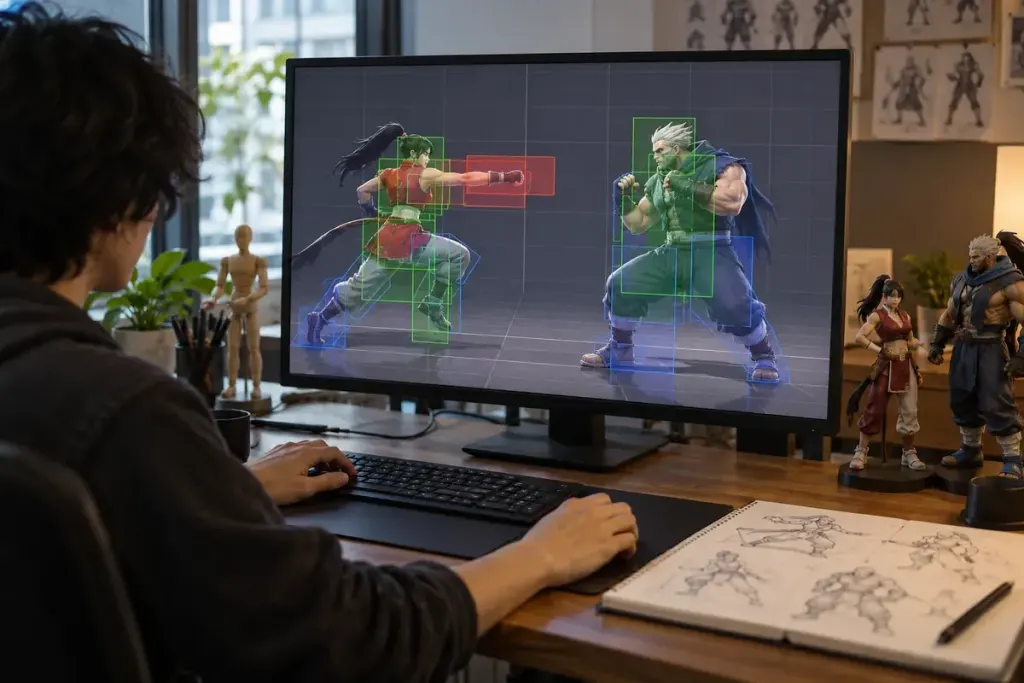
A sword appears to pass through a character, but no damage registers. Another attack seems to connect slightly before the visible blade arrives. The artwork is not necessarily the exact shape the game uses to decide a hit.
In common fighting-game terminology, an attack’s active area is called a hitbox and an area that can receive the hit a hurtbox. Terminology varies between engines and games. Epic’s glossary, for example, uses “hitbox” more broadly for collision geometry, while its Parrot sample documentation discusses a hurt-box volume in the game’s interaction logic.
A visible overlap is only part of the question
Imagine an original practice game in which a punch has an active area for only a few frames. The fist can still be drawn during its wind-up and recovery, even when that attack area is inactive. A target can also temporarily lack a vulnerable region during a particular action. The visual pose alone does not establish that a valid collision occurred.
The shapes may be rectangles, capsules or other volumes rather than a precise tracing of the character. Their job is to support the game’s rules and performance. Clothing, particles and decorative weapon trails can extend beyond the areas used for damage detection.
Review one controlled situation
If the game offers training tools or an official collision display, repeat the same move at the same distance and timing. Change one factor at a time. Record the game version and whether the result was observed offline or online.
Online delay, rollback, invulnerability, armour and attack-specific rules can complicate a clip. Do not diagnose a broken hitbox from one compressed video where the relevant frames or game state are missing.
The useful question is not only “Did the pictures touch?” It is “Were the required collision areas active and interacting under this move’s rules?” That distinction turns a frustrating miss into something you can investigate without inventing a hidden damage rule.