
A large attack finishes its visible swing, and you move forward—only to be hit by its final active moment. Reading the animation as one undivided event makes it harder to understand when the danger begins and when an opening really appears.
Capcom’s explanation of attack composition separates startup, active frames and recovery. Startup leads into the damaging phase; recovery follows it before normal action resumes. The exact implementation depends on the game, and projectiles or multi-part attacks can complicate the simple picture.
Three questions for one move
- Startup
- Which visible cue begins the move before it can connect?
- Active period
- When can this part of the attack actually hit at your current distance?
- Recovery
- When does the opponent regain the relevant action options?
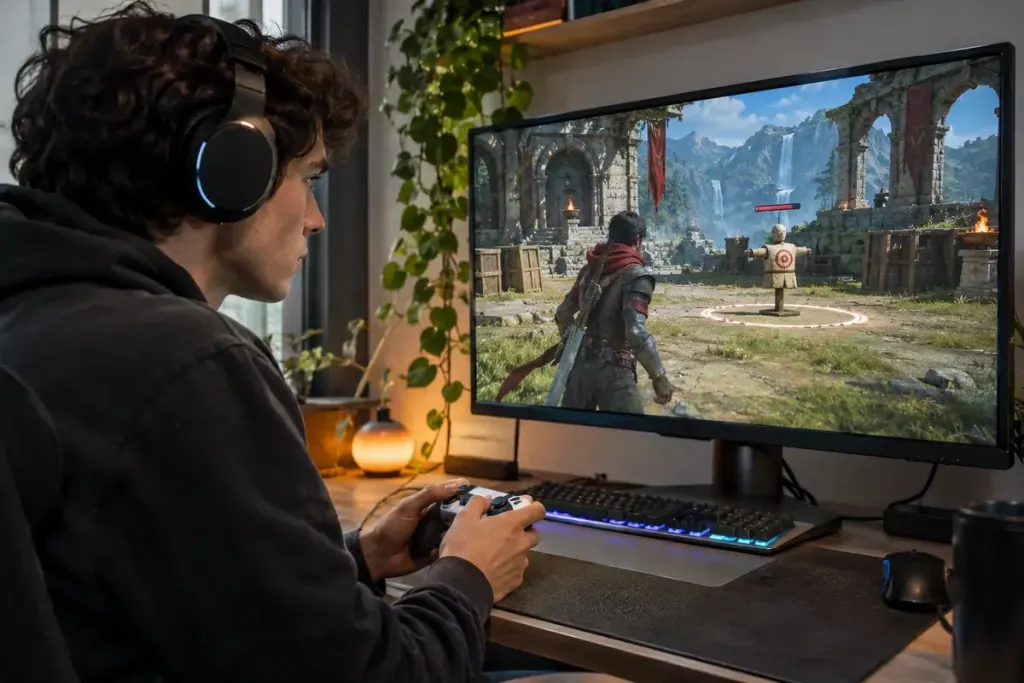
Use a training mode or another low-cost practice situation. Repeat the same attack and observe three moments: the first reliable cue, the period in which it can connect, and the point at which the opponent can act again. If the game provides a frame display, use its own documentation to interpret it.
Keep distance consistent during the comparison. A move can miss because you are outside its range, not because the active period has ended. Likewise, a slow-looking animation may still have a lingering hitbox.
Try a small, reliable response before a long combination. Record whether it succeeds after a miss, after a block or only at a particular spacing. Those are different conditions; “punishable” without context is an incomplete note.
Do not carry one game’s timing into another
Cancel rules, armour, follow-ups and recovery options differ. A boss encounter may also change its sequence by phase or distance. Treat the three-part model as a way to ask better questions, not a promise that every attack creates the same safe opening.
After practice, write one specific observation: “At this distance, the second swing remains active longer than the first.” That gives the next attempt a useful target. It is more actionable than blaming reaction speed every time an animation catches you.